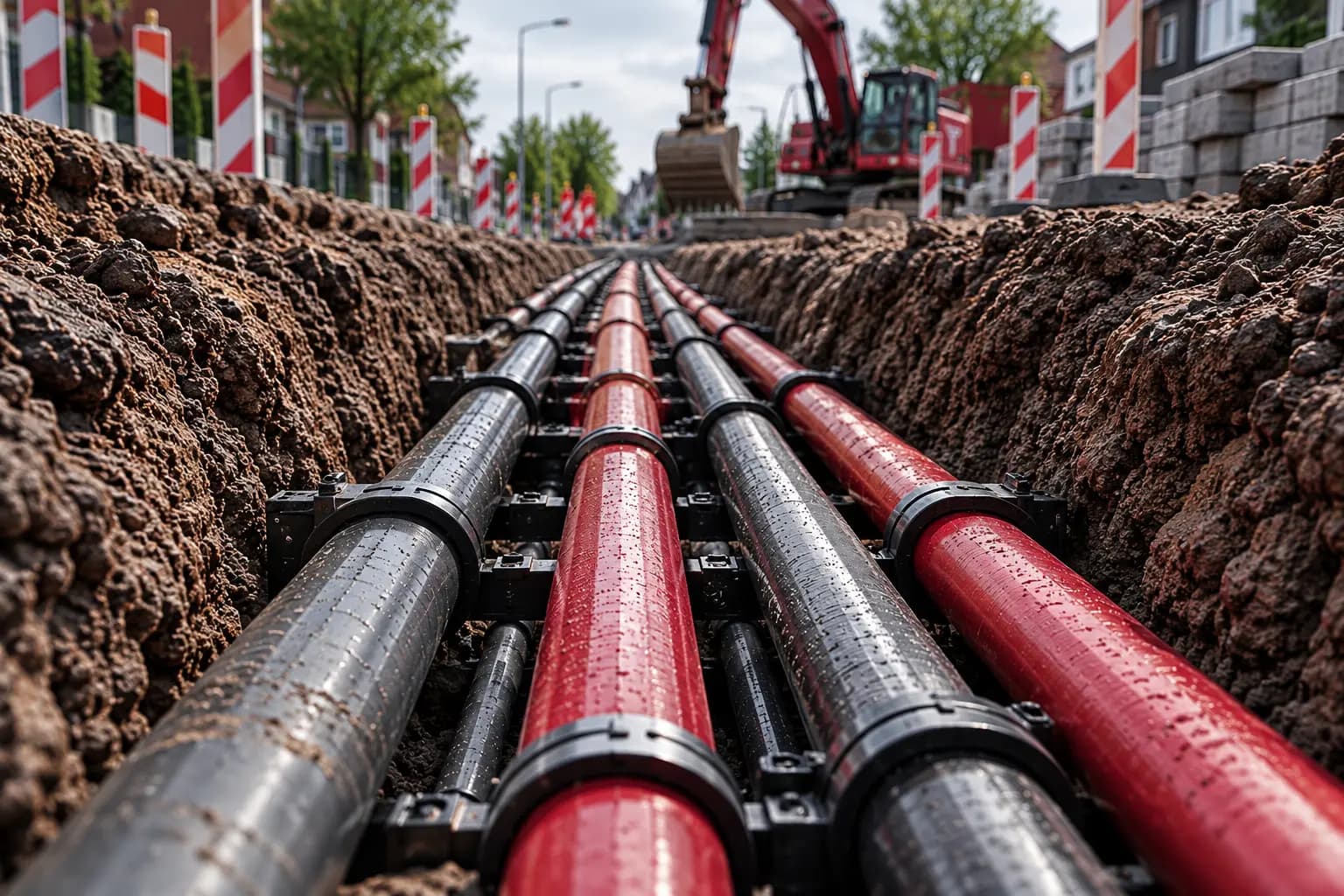
From KLIC notification and trial trench to a buildable design. One team, one file.
Trayect produces engineering drawings and route plans for grid operators, contractors and engineering partners. You follow every step live in our client portal.
Engineering for cables and pipelines: Drawnforcertainty.
Route engineering
Trial trenches
KLIC notifications
CROW 500 interfaces
Drilling plans
Permits
Surveying
As-built drawings
NLCS
Route engineering
Trial trenches
KLIC notifications
CROW 500 interfaces
Drilling plans
Permits
Surveying
As-built drawings
NLCS
Who we work for
Engineering that works in the trench, not just on paper.
We work for parties who need a cable or pipeline project to succeed. Whether you manage the grid, carry out the work or commission it: you get one point of contact and a design tested in the field.
A · Construction and grid operation
For contractors and grid operators
Buildable drawings to NLCS and the grid operator’s requirements, with interfaces agreed in advance. No surprises during construction.
From an initial route study to permit and handover file. You see in advance what is in the ground, what the project affects and which steps are needed.
Available separately or as a complete package. Because design and fieldwork sit with one team, what we find in the trench goes straight back into the design.
>Command:1:20
D.01
Route engineering and CAD
Cable and pipeline routes for medium voltage, low voltage, gas, water and data. From preliminary design to a buildable drawing set to NLCS.
KLIC notification, site conditions and permit applications, submitted and monitored. Coordination with municipalities, grid operators and other stakeholders.
Every drawing matches the situation in the field. Where the KLIC data leaves doubt, we dig a trial trench and survey the position, so the design rests on facts.
Process
Six phases, from request to handover.
Each phase has a fixed deliverable. At three moments we ask for your formal approval: the preliminary design, the detailed design and the handover file. You follow everything live in your project file.
You submit the assignment: the intended route or the request to determine it. We file the KLIC notification and read the delivery straight away, per grid operator and per theme.
DeliverableKLIC delivery read per grid operator and theme
02
Site conditions quickscan
The route is checked for soil, groundwater, nature, archaeology, UXO and ownership. One outcome per topic and, where needed, a next step.
DeliverableQuickscan report with an outcome per topic
03Your approval
Preliminary design (PD)
A second engineer reviews the PD before it reaches you. You approve it in the portal, with name, time and version recorded.
DeliverablePD drawing, checked by a second engineer
04
Trial trenches and surveying
Where the subsurface is uncertain, we dig a trial trench and survey. What we find goes straight back into the design.
DeliverableTrial trench report and survey in RD
05Your approval
Detailed design and permit
Interfaces get a risk class under CROW 500 and a measure. Permit applications run in parallel.
DeliverableDD/CD drawing set, interface register and permit application
06Your approval
Handover
The complete file: DXF in RD coordinates, interface register and all underlying documents. Everything stays available in the portal.
DeliverableHandover file with DXF in RD coordinates
In a hurry? We’ll give it priority.
For an outage, an emergency or a deadline that can’t move, we schedule your project right away.
What you’re used to from an engineering firm, and what we do differently.
Fieldwork, design and permits sit with one team. You see in the client portal where your project stands, and you know the cost upfront.
01
Project status
TraditionalAsked for by email or phone
TrayectLive in the client portal, per step of the route
02
Field and drawing board
TraditionalFieldwork often outsourced
TrayectOwn team for surveying, trial trenches and design
03
Approvals
TraditionalApproval by email, hard to trace
TrayectFormal approval of PD, DD and handover, with name, time and version
04
Drawing standard
TraditionalVaries per draughtsman
TrayectNLCS and each grid operator’s requirements, checked by a second engineer
05
Reviewing drawings
TraditionalEmailing PDFs back and forth
TrayectView in the browser, approve or reject with a note
06
Project data
TraditionalUnclear where files are stored
TrayectOn our own servers in Germany, with mandatory MFA
Client portal
No more status emails. See it for yourself.
In the client portal you follow each project step by step. You view drawings in the browser, approve or reject them with a note, and ask the team questions per project.
→28-step route with owner and schedule
→Formal approval of PD, DD and handover: who, when, which version
→Mandatory MFA, data on our own servers in Germany
Drawings to the Dutch CAD standard, plus each grid operator’s requirements.
CROW 500
Interfaces and risks around cables and pipelines recorded with measures.
DNR 2025
The client–consultant legal framework on all our work.
VCA
Safe working on site for trial trenches, surveys and inspections.
MFA
Mandatory two-factor authentication for every client portal account.
EU data
Project data and drawings on our own servers in Germany.
Knowledge base
Knowledge on routes, cables and pipelines.
Free tool
Request a route quickscan
Send in your intended route. We check it for the main bottlenecks, such as nature, archaeology, UXO and land ownership, and tell you where the risk lies.
Submit a project or ask a question. We’ll get in touch to discuss the assignment and the schedule.
Trayect handles the engineering of cable and pipeline projects, from KLIC notification and trial trench to a buildable design and handover file. Design and fieldwork sit with one team, so what we see in the field goes straight into the drawing.